

The Veneration of Relics
Reexamine the Catholic and Orthodox practice of honoring remains of the Saints
Reexamine the Catholic and Orthodox practice of honoring remains of the Saints
Time to read: 7 minutes.
For many Protestant Christians, the veneration of relics feels immediately unsettling. A fragment of bone, the clothing of a saint, and the tomb of a holy person become objects of pilgrimage, kissing and bowing. To many modern, especially protestant, believers, this looks straight like idolatry, pure and simple.
Yet before judging the practice, it is worth understanding the reasoning behind it.
Catholic and Orthodox reasoning behind honoring relics grows out of something central to the gospel story: the incarnation and, therefore, the affirmation and sanctification of embodied, material creation that God reclaims for Himself in Christ.
Historic Christian orthodoxy has never regarded matter itself as evil. At its center stands the astonishing claim that “the Word became flesh” (John 1:14). God did not simply send ideas down from heaven. The Son of God took on a physical human body. Jesus touched lepers, put His fingers into the ears of a deaf man, used saliva to heal, broke bread, poured wine, washed feet, died in the flesh, and rose bodily.
The incarnation gives matter an extraordinary dignity, showing that the physical world is not something God keeps at arm’s length. The physical world is not something God remains distant from. He made it, entered it, and works through it.
Behind relic veneration lies a deep conviction about the holiness of the body. Paul writes, “Your body is a temple of the Holy Spirit” (1 Cor 6:19). The body is not disposable packaging for an immortal soul; Christian hope includes its resurrection. Holiness, then, is never merely inward. A believer who spends decades praying, fasting, serving the poor, and enduring hardship has served God with this very body/temple of the Holy Spirit. Hands served, knees bent, eyes wept, feet carried the gospel, and sometimes blood was shed.
Yet Scripture also gives a solemn warning. God once used Moses’ bronze serpent as an instrument of healing (Num 21:8–9). Centuries later, however, Israelites were burning incense to it. King Hezekiah destroyed it and called it Nehushtan, simply “a piece of bronze” (2 Kgs 18:4). What God had once used had become a rival focus of devotion.
The same danger remains. God may work through material means, as He did through Peter’s shadow and cloths associated with Paul (Acts 5:15; 19:11–12). But the New Testament never teaches that such objects retain automatic or permanent power. The channel must not become the object of confidence.
There are several striking texts that Catholic and Orthodox believers appeal to when seeking to establish the biblical precedent.
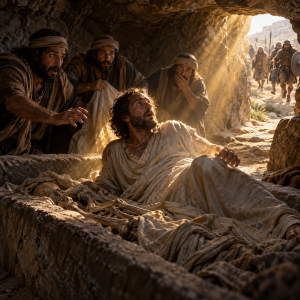 For example, after the great Old Testament prophet Elisha died, a dead man was resurrected when his corpse accidentally came into direct contact with the bones of the prophet. When the burial party saw Moabite raiders, they hastily threw the man’s body into Elisha’s tomb. When it touched Elisha’s bones, ‘he revived and stood on his feet’ (2 Kgs 13:21).
Acts offers equally striking cases. Luke tells us that extraordinary signs were performed through the apostles, especially Peter, so that the sick were carried into the streets “that as Peter came by at least his shadow might fall on some of them” (Acts 5:15). Crowds came from the surrounding towns bringing the sick and those troubled by unclean spirits, “and they were all healed” (Acts 5:16). Luke records their hope that Peter’s shadow might fall on them, followed by a summary that the sick were healed (Acts 5:15–16). He does not explicitly state that Peter’s shadow itself healed anyone.
But Acts 19 pushes the pattern even further. “God was doing extraordinary miracles by the hands of Paul, so that even handkerchiefs or aprons that had touched his skin were carried away to the sick” (Acts 19:11-12), and diseases and evil spirits departed. These texts complicate any simple claim that God does not work through physical objects. At times, He does.
Note: Catholic tradition commonly distinguishes different classes of relics. First-class relics are bodily remains of a saint; second-class relics are objects personally used or owned by the saint, such as clothing, a prayer book, or other possessions; and third-class relics are objects that have been touched by a saint’s body or relic. Official Catholic documents today more often speak of bodily remains and notable portions as particularly significant relics, while also recognizing personal belongings and objects that touched the saint’s body or tomb as relics. Here, ‘saint’ refers to a holy Christian who is honored in the Catholic or Orthodox tradition. In Catholic practice, formal recognition authorizes public ecclesial veneration, though Christians also use the term ‘saints’ more broadly for all of God’s holy people. You can probably already see how some of these ideas could be linked, at least in theory, to the biblical texts mentioned above.
Many modern Protestants instinctively interpret gestures such as kissing, bowing before, or touching a sacred object as acts dangerously close to worship.
However, people are known to express honor through physical objects that are entirely unrelated to worship.
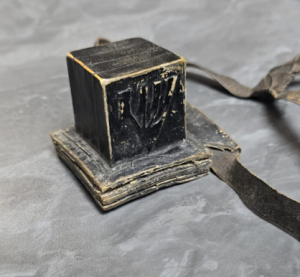
Tefillin of my great-grandfather, 1905, Russian Empire. Now it is home in the Land of Israel.
We kiss photographs of those we love. We keep a deceased parent’s Bible. We visit the grave of someone who shaped our lives. A soldier stands at attention before a flag.
Incidentally, Catholic official teaching separates the worship owed to God alone from the honor (not worship) that is due to His saints. That distinction is worth taking seriously, even for those who remain uneasy with the practice itself (me included!).
Just yesterday with great reverence I came into contact with tefillin (Jewish prayer gear) from 1905, which my great-grandfather Eliyahu Girzshil received on his bar mitzvah at the age of 13. It was truly significant to look at this relic that my great-grandfather Eliyahu, whom I am named after, left behind. My nephew Eitan (I held him in my hands at his circumcision ceremony) is planning to lay this very tefillin on his school trip to Poland as they enter Auschwitz death camp, where many Jews died in Nazi-occupied Poland. You can’t make this story more moving, at least for me personally. It connects me to the faith and prayers of my great-grandfather in a way that nothing else does.
Commenting on the episode of Caleb and the spies, the Babylonian Talmud (Sotah 34b) interprets the singular wording in Num 13:22, “he came to Hebron,” as referring specifically to Caleb. According to this rabbinic tradition, Caleb separated himself from the other spies, went to the graves of the patriarchs, prostrated himself there, and pleaded, “My fathers, ask for mercy upon me,” so that he would be delivered from the counsel of the other spies. Whatever one concludes about the plain meaning of Num 13:22, this rabbinic interpretation is revealing. It shows that Jewish sages could understand the graves of Israel’s patriarchs not merely as memorial sites, but as places where the living could appeal to the righteous dead to intercede with God on their behalf.
Today Jews pray at the Cave of Machpelah in Hebron (my wife and I prayed there fairly recently), where Abraham and Sarah, Isaac and Rebekah, and Jacob and Leah are traditionally understood to be buried. Abraham originally purchased the site for Sarah’s burial (Gen 23; 49:29–31). The name “Machpelah” is related to the Hebrew idea of doubling and is traditionally understood as referring to the “double cave.” Jewish visitors direct prayer to the God of Abraham, Isaac, and Jacob, though Jewish customs and theological understandings of prayer at graves are not uniform.
Jewish practice is not identical to Catholic or Orthodox relic veneration, and there are significant differences, but the comparison illuminates something shared: an instinct, deeply rooted in Jewish tradition, that persons, bodies, places, and memory remain bound together.
Possibility Is Not Command
Elisha’s bones, Peter’s shadow, and Paul’s handkerchiefs each show something God was able to do in a given moment. None of them comes attached to an instruction. 2 Kings records the resurrection at Elisha’s tomb once, and nothing follows it, no shrine, no repeated ritual, no command to seek a prophet’s remains again.
Yet within a few generations, some Christians began gathering and honoring the bones of their martyrs. The Martyrdom of Polycarp, generally regarded as one of our earliest martyr accounts, describes believers gathering his bones as more precious than gold and jewels, while insisting that worship belongs to Christ alone. The same account takes care to distinguish the practice from worship, which belongs to Christ alone.
So the historical record holds two things side by side without resolving them: Scripture never commands relic veneration, and some Christians embraced a version of it quite early anyway. Recognizing a possibility is different from receiving a command and from issuing a prohibition. Both directions overstate what the text actually provides us.
Conclusion
Relics are not the point. They are signposts. When honor becomes worship, the signpost eclipses the destination. But when a bone, a garment, or a grave draws a soul toward the God who became flesh, suffered, and rose, it fulfills its purpose. The question is never merely whether a practice is biblically precedented, but whether it leads us to Christ or away from Him. Every devotion, every gesture, every tradition must finally answer that question. Hold loosely the things that point, and cling tightly to the One who saves. For the God who once worked through Elisha’s bones and Paul’s handkerchiefs still works today. Let every practice, ancient or new, be measured by this alone:
Does it lead you to God in Christ Jesus rather than gradually taking His place? If yes, receive it with gratitude. If it does not, let it go without regret.
More from me: I genuinely need your partnership to keep this ministry growing! Please consider making a gift or, even better, a monthly contribution of a moderate amount. Your support will allow me to focus more deeply on teaching and mentoring Christian leaders from all around the globe. To support, click HERE.
Comments (26)
This is a great piece. Thanks so much!!! I agree with your observations.
I am a witness in how veneration becomes worship easily.
Thank you, Willy! Praying for the people of Cuba!
Very good and balanced article by Dr Eli. It would be easy to use the catholic use of relics and "holy pictures" as a big stick with which to beat them. As a practicing catholic the use of relics, holy pictures and statues is more an expression of deep humility than any religious aberration. Indeed, it is a joy to behold a congregation in unison praying the beads of the rosary. Amen
Thank you, Aidan for sharing.
I agree that we need to consider the theological context and reasoning behind the veneration of relics before immediately concluding that it is idol worship. There is an important distinction between honoring something because of what it represents and worshiping the object itself.
That being said, I believe there is a genuine risk when Catholics, Christians, or others participate in these practices without fully understanding the theology and symbolism behind them. When the line between honoring a sacred symbol and directing devotion toward the object itself becomes blurred, veneration can unintentionally cross into idolatry. Intent, understanding, and ultimately where one directs one’s heart in worship is what matters from my perspective.
I am certain the danger is there. On the other hand, it will only make it wrong if there is no danger (probably a stupid example; some would say mountain climbing and a bunch of other things people do for sport are not wrong just because they are dangerous). Again, I am not a Catholic and have serious reservations about this practice. So happy we can even have this conversation!
Very insightful reminder for us Catholics. All my prayer support for your continued sharing Dr. Eli
Thank you so much, brother Victor!
That really is vastly improved and extremely helpful, thank you.
Thanks so much!
I am so grateful to those of you who have decided to help me grow this ministry! May God bless you and keep you! If you are interested in making a contribution of any size, whether one- time or ongoing, please click here.
Great article, Dr. Eli. This would be very appropriate here in the Philippines where tradition and superstition trump biblical instruction. Statues have supposedly taken a life of their own and perform miracles. Thanks for bringing clarity to this matter.
Thank you, Ramon. I did ask my friend Fr. David Neuhaus (he is a Jesuit priest, former St. James vicar for the Hebrew Catholics in Jerusalem) to tell me what his thoughts were on the article. He wrote to me, "The article is very fair, and its conclusion hits the nail on the head!"
We have allowed ourselves to give the Roman Catholic system the title of "Catholics" when we should also precede that title as "Roman." Remember there were 7 churches - all of them one Catholic (Universal) body of Christ. Rome broke away from the other 6 over a millennium and gave itself pre-eminence over the others. There was recently a movement in Roman Catholicism to not only "venerate" the Virgin Mary, but to align her as a "co-redemptorate" with Christ. That goes way beyond "honoring or venerating" her. As for Peter's shadow having literal healing power, I would suggest that the Greek tense and syntax might leave open the possibility that a figure of speech was being applied, referring more directly to Peter's presence (If my training by Dr. Verlin Hinshaw has correctly pointed me in that direction."
Yes, I heard about it, and it was deemed controversial. I think what is behind this is the idea that Jesus is the first Adam and his mother is the second Eve in Catholic theology. But perhaps there is someone here in the forum who is a serious catholic believer and knows about the topic and can weigh in further.
Grace and mercy upon you Eliyahu. Thank you for the clarification of the issue of veneration of holy relics. I am a Greek Orthodox Priest and this is exactly what we do. We venerate holy relics of the Saints. Veneration to the Saints and adoration to Massiah alone. Something that our Protestant brothers do not grasp. God bless you.
Dear Rev. Dr. Christos Tsoraklidis, thank you very much for providing your feedback. God bless you!
What an excellent explanatory sermon ! The distinction between veneration and worship is so frequently misunderstood because the terms used are seldom clearly explained. Nowadays the term worship is used to include a wide variety of activities ranging from singing dancing and talking to private prayer.Some of the music could put people off praying ! As God is in all things and in numerous examples uses the material of the world in ways we cannot understand it is hardly surprising that we recognise relics of the presence and work of God as material we wish to be close to and the existence of these relics allows us to meditate on the presence of God through the ages. That meditation,that communication, that acknowledgment is prayer with God. The relics are stimulants.The Protestant argument seems to be predicated on God as a mystical being remote from physicality and not having a real and direct connection with the material world. What a pity that such a limited perception should have led to such destruction and antagonism for many centuries.I have always found a logical gap in the argument that those who have completed life on this earth have no life thereafter recognised by those who are alive and those who have followed the precepts of the life of Christ essentially do not exist in the minds of those who are treading the path still on earth.
Superstition is part of human nature.It has impinged on all religions pagan and non pagan and non religious. When there is clear explanation of the difference between superstition, the existence of life hereafter, and connection between God and the material world it seems to me to be an easy concept to distinguish between respect for material world and communication with - may I use a Hebrew word ?ABBA. Thank you for raising this topic. I am sorry if I have taken too many words to essentially agree with your conclusions.
Dear Kieran, I am very grateful for your comments, encouragement and support! It means a lot!
Dear Dr. Eli in the Catholic world which is mixed with paganism; a saint has to perform a miracle after dead when somebody prayed to him or her. This is why people believe in a particular saint and pray to him. This contradicts praying to God only and not to call the dead. I do not know if jews pray to Moses? Jewish traditions are not a guide to followers of Christ. .
Thank you, Ana Margarita. Your concern is an important one. Catholic and Orthodox Christians distinguish worship, given to God alone, from asking departed saints to intercede. Protestants, however, reasonably ask where Scripture instructs believers to address the departed at all. Revelation pictures heavenly beings presenting prayers to God (Rev 5:8; 8:3–4), but it does not explicitly show Christians praying to saints.
Scripture consistently directs prayer to God through Christ (Matt 6:9; John 14:13–14; 1 Tim 2:5). It also forbids seeking the dead for spiritual knowledge or power (Deut 18:10–12). Therefore Christians should be very cautious wherever devotion to a saint begins to function as reliance upon that saint.
Jews have long visited graves of righteous people, but the Torah contains no example of Israelites praying to Moses. Indeed, Moses’ burial place is unknown (Deut 34:5–6). Jewish practice can illuminate historical background, but it is not the final authority for followers of Jesus. Scripture and allegiance to Christ must remain central.
I am so grateful to those of you who have decided to help me grow this ministry! May God bless you and keep you! If you are interested in making a contribution of any size, whether one- time or ongoing, please click here.