




The Covenant Marked in Flesh
Why only males were circumcised on the eighth day and why it mattered.
Why only males were circumcised on the eighth day and why it mattered.

Time of reflection: 7 minutes.
In the Hebrew Bible, circumcision is not simply a medical procedure or ethnic custom. It is the covenantal sign God gave to Abraham, required of the males in his household and his descendants. Later Judaism calls this rite בְּרִית מִילָה, brit milah, “the covenant of circumcision.”
The English word “circumcision” is accurate, but it can sound clinical and miss the biblical setting. In Hebrew, covenants could be described with the verb “karat,” meaning “to cut,” as in covenant-making contexts involving divided animals (Gen 15:9-18; Jer 34:18-19), yet “brit milah” itself simply means “covenant of circumcision.”
Why did God choose this sign? Why was it given only to males? Why was it required on the eighth day? Scripture gives clear commands and meaningful patterns and also some questions it does not directly answer.
God’s covenant with Abraham was established before circumcision was commanded; after Abraham trusted the LORD, it was credited to him as righteousness (Gen 15:6). Genesis 17 then identifies circumcision as the sign of that covenant:
“I will establish My covenant between Me and you and your descendants after you throughout their generations for an everlasting covenant, to be God to you and to your descendants after you” (Gen 17:7), and “You shall be circumcised in the flesh of your foreskin, and it shall be the sign of the covenant between Me and you” (Gen 17:11).
Circumcision did not create God’s promise or earn Abraham’s righteousness. It marked the household to whom God had pledged Himself, calling Abraham and his descendants to belong to the God who had already graciously called them.
The command extended beyond Abraham’s biological line: every male born in his household, including slaves born there and those purchased from foreigners, was to receive the sign (Gen 17:12-13). This did not make them ethnically Israelite, but it shows the covenant household was larger than blood descent alone and that those incorporated into it shared its responsibilities and identity.
The sign was given to infant boys on the eighth day, before they could understand it or choose obedience. Israel’s existence did not begin afresh with every individual decision; God’s covenantal faithfulness preceded each new generation, and parents were responsible for teaching their children to know, fear, and love the LORD (Deut 6:4-9). It is much like a baby born into a country’s citizenship, who only later grows into a citizen who knows both rights and responsibilities.
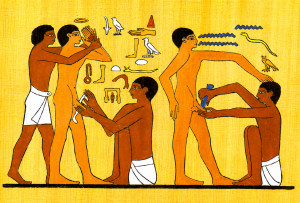 Circumcision was not unique to Israel; ancient Egypt practiced it long before the biblical period, though there it was tied to status, priesthood, or the transition into adulthood. The biblical practice was distinctive: required for Abraham’s household, including infants, and explicitly tied to God’s covenant rather than offered as a rite of passage or a mark of social rank. It was a bodily sign of belonging to the God who promised descendants, land, and His enduring presence, private in the mark but public in meaning.
The Bible never explicitly says why circumcision was limited to males, and we should resist speaking as though we know God’s full explanation. Still, the placement of the sign fits the language and social world of Genesis: God repeatedly promises Abraham that his “seed,” his offspring, will become a great people and bring blessing to the nations (Gen 12:2-3; 15:5; 17:4-8), and biblical genealogies ordinarily trace descent through fathers, with circumcision placed upon the male organ associated with begetting offspring.
This does not mean women stood outside the covenant. Sarah receives God’s promise by name, and God says kings and peoples will come from her (Gen 17:15-16); Rebekah, Rachel, Leah, Hannah, and many other women are indispensable to Israel’s covenant story, yet Genesis 17 assigns this particular sign to males. That should not become a simplistic explanation that women were spiritually secondary; the covenant promise embraced the whole family, while its physical sign was carried in male flesh.
The prophets made clear that physical circumcision could never replace faithful hearts. Moses called Israel to “circumcise” its heart, removing stubbornness before God (Deut 10:16), and Jeremiah warned in the same terms (Jer 4:4). Scripture also speaks of uncircumcised ears that refuse to hear God’s word (Jer 6:10), and Paul draws on this language for a circumcision of the heart by the Spirit (Rom 2:25-29). The outward sign mattered deeply, but God always sought inward faithfulness.
God’s instruction is precise:
“Every male among you who is eight days old shall be circumcised throughout your generations” (Gen 17:12; cf. Lev 12:3).
Yet neither passage tells us why God chose that day.
Some readers point to a broader biblical pattern. The eighth day often follows a complete period and marks a new stage of restored participation or consecrated service: Aaron and his sons remained at the tent of meeting for seven days before their priestly ministry began on the eighth (Lev 8:33-9:1), and those healed from certain skin diseases completed their purification on the eighth day (Lev 14:10). After the seven days of Sukkot, the Torah likewise commands a sacred assembly on the eighth day (Lev 23:36; Num 29:35), later called Shemini Atzeret. These are not a rigid formula but a recurring rhythm of completion and new service before God.
A medical explanation should not be made the foundation of the command. The popular claim that vitamin K or blood clotting peaks on day eight is not a sound basis for biblical interpretation; newborns simply have low vitamin K levels, which is why modern medicine recommends it at birth. The meaning of the eighth day must arise from Scripture itself.
Jesus was born into this covenantal world. Luke records that “when eight days had passed, so as to circumcise Him, His name was then called Jesus” (Luke 2:21). He was circumcised as an Israelite boy, in obedience to the command given to Abraham. This does not mean he needed forgiveness; it shows his full participation in the life of Israel and his faithfulness to the covenant story from which he came. The Messiah did not arrive detached from Abraham, Torah, and promise; he entered that story from within.
The Gospels say Jesus’ tomb was found empty early on the first day of the week (Matt 28:1; Mark 16:2; Luke 24:1; John 20:1). Christians later called that day the “eighth day,” not because the New Testament uses that phrase for the resurrection, but because Sunday begins a new weekly cycle after the seven-day Sabbath rhythm. The symbolism fits: the first day recalls creation, while the “eighth day” speaks of creation renewed beyond its old cycle, and Jesus’ resurrection inaugurates that new creation (2 Cor 5:17).
Jesus is also the “last Adam” who brings life where the first Adam brought death (1 Cor 15:45). Through Abraham’s Messiah, the promise reaches outward to the nations: those who belong to Christ become Abraham’s offspring and heirs according to the promise (Gal 3:28-29). This does not erase Israel or dissolve God’s faithfulness to His people; it reveals the worldwide purpose already present in the promise that through Abraham all families of the earth would be blessed (Gen 12:3).
Circumcision on the eighth day serves as a powerful emblem of divine promise, transformation, and renewal, woven into the fabric of God’s covenant with humanity. From Abraham’s obedient faith to Jesus’ resurrection, the eighth day threads a narrative of hope through Scripture, marking sacred moments of consecration and new beginnings. This rhythm reflects God’s design, where physical and spiritual realities intertwine, inviting us into His eternal story. Jesus, circumcised and risen, fulfills God’s covenant purposes and extends its promised blessing from Abraham, Isaac, and Jacob and their children to all the nations of God’s world. The covenant, etched in flesh, resides in the heart, calling us to lead with love, protect with courage, and live generously. Embracing our place in this divine narrative, let us rise, transformed, to walk in faith, embody hope, and reflect the unbreakable promise of a God who makes all things new.
Important from me: I genuinely need your partnership to keep this work growing. Please consider making a one-time gift or, if you feel led by God, a monthly contribution (remember, every gift, big or moderate, is truly needed!). Your support allows me to focus more deeply on teaching and less on administration and helps bring these insights to believers and seekers across the globe. To support, click HERE or below.
Comments (46)
This was really great.There have often been jokes and unexplained questions on this subject matter;I've always paused with God knows what He Is doing...Thanks for the work and effort here.
Blessings, Helen! Thank you!
A very interesting article with lots of clarifion on the subject of circumcision. It was Moses wife Zipporah who performed circumsion on their son.
You should also read this one - https://jewishstudiesforchristians.com/did-god-try-to-kill-moses-or-his-son-gershom-and-why/
Jesus/Yeshua/Yehovah's salvation was given His name and circumcised on the 8th day, meaning Shemini Atzeret. And people wonder why the bible doesn't tell us when Jesus was born when it is right there in plain English- the 15th of Tishri.
Thank you, Laurence.
בְּרִית מִילָה - brit milah, “the covenant of circumcision” - I note a side issue of Hebrew words that are spelled the same or are pronounced similarly and have a relationship. The Hebrew noun מֶלַח (melach) means 'salt'. Matthew 5:13, states, "You are the salt of the earth. But if the salt loses its flavor, how can it be made salty again? It is no longer good for anything, except to be thrown out and trampled underfoot." Circumcision is similar to adding flavor to a dish, raising it to special notice, separating that morsel from all of the other morsels of the meal - a special delight. While circumcision is not voluntary to the 'morsel' that receives it, it gives special delight to the one who feasts upon it. 🤔 🙂
Thank you for looking so closely at the Hebrew words. Scripture does connect salt with covenant faithfulness in places such as Num 18:19 and 2 Chr 13:5, so your instinct to pay attention to its symbolism is a good one.
However, brit milah (בְּרִית מִילָה) and melach (מֶלַח) are not the same word or from the same root. Milah is related to circumcision, while melach means salt. Their resemblance in English transliteration can invite an association, but the Hebrew text does not make one.
It is also important to keep the covenant sign’s meaning clear. Circumcision marks Abraham’s descendants as belonging to God and calls them to covenant faithfulness (Gen 17:9–14). It should not be treated as an ornament or as a way of objectifying the person who bears it. Biblical word connections can be illuminating, but only when the text itself supports them.
The covenant with Abraham was indeed Land, Seed but also Priesthood to bless all nations?
Yes, that is a very helpful way to frame it. Genesis explicitly promises Abraham land, descendants, and blessing for all families of the earth (Gen 12:1–3; 15; 17). It does not directly call Abraham a priest, but his calling has a priestly dimension: he builds altars, intercedes for others, and is chosen so that through his family the nations may be blessed.
Later, that vocation becomes explicit when Israel, Abraham’s seed, is called “a kingdom of priests and a holy nation” (Exod 19:6). Israel was not chosen merely for privilege, but for service: to make the one true God known among the nations.
This conversation is possible because friends and family choose to support this ministry (Thank you so much!). If my teaching has helped you read the Bible more deeply in its Hebrew and Jewish world, and if you are in a position to do so, please consider joining my support team or giving again if you did in the past. Your monthly gift, no matter the size, helps me continue teaching, writing, and engaging with pastors, priests, Bible teachers, and serious students of Scripture worldwide. To support my work, click HERE.
I agree with Velani. The science that we know now does not conflict with Scripture, it only enhances our understanding of it. It just took medical science a long time to catch up with what God had already told us. God is the Author of our health and healing! Amen? For instance, when we read the biblical laws of "clean" and "unclean" in regard to daily living no one knew about germs, viruses, and etc. but it sure saved many Jews from the bubonic plagues and they taught medical doctors about cleansing their hands before treating other patients and spreading diseases because they kept these laws. It also took science a long time to catch up with the information found in Isaiah and Job. They go hand-in-hand beautifully!
Thanks for weighing in, Juldine.
Dr Eli, thank you. This is good stuff, I would still maintain that both the biblical basis and the medical observations need not counter or complete with each other. Surely the Ancient of days is also the one that formed man in all his/her individual constituents. I do concede though that the word of God must precede all else. I must say, I feel a little trepidation here as I see some replies seem rather irascible in a forum that should otherwise be for open-mindedness and readiness to re-examine our beliefs as we grow (surely we rest our central faith in one greater than theological differences).
Thank you for sharing, Velani. This is a safe place to think together.
I have to admit, I have taught the eighth day for quite some time to many laughs and ridicules. This actually gives a bit of new light not only from the exchange from the Old Testament to the New Testament, but a rich background to form factual proof of that which is “argued”. Keeping an open mind can and will be respected for the truth it holds. Thank you Dr.
Blessings, my brother! May the Lord bless you in your ministry! (for those who don't know what "Dcn." is: It is a standard abbreviation for a deacon in some churches.
Thank you for expounding on this. I had accepted the medical reason for 8th day, but God's repeated pattern of the 8th day marking a new beginning makes a lot more sense. Circumcision is simply an outward and visible sign of God's covenant with Israel. Jewish days are sundown to sundown . . . Jesus did rise on the 8th day.
Yes, one thing though: we should remember that it was on Saturday night, not Sunday morning (it is still the 1st/8th day). Early Sunday morning the grace was confirmed to be empty by the eyewitnesses.
Genesis 34 tells a sorry story about the people of Shekem who befriended Jacob and his family who then turned on the people of Shekem after enticing all the males to be circumcised, so that they were unable to defend themselves, they were then massacred.
Genesis 33 is referred to by the Freemasons as it contains the name of their god, El-El-O-Eh-Israel; God-God-Of-All-Israel and the story in 34 is an exemplar of “Right conduct” (From the rituals of the Holy Royal Arch)
Alison, I dealt with some of it here - https://jewishstudiesforchristians.com/the-cutting-edge-of-faith/
This conversation is possible because friends and family choose to support this ministry (Thank you so much!). If my teaching has helped you read the Bible more deeply in its Hebrew and Jewish world, and if you are in a position to do so, please consider joining my support team or giving again if you did in the past. Your monthly gift, no matter the size, helps me continue teaching, writing, and engaging with pastors, priests, Bible teachers, and serious students of Scripture worldwide. To support my work, click HERE.