



The Hebrew Acrostic on the Cross
Discover how Pilate retaliated against the Jewish leaders who tried to blackmail him.
Discover how Pilate retaliated against the Jewish leaders who tried to blackmail him.

Time to read: 7 minutes.
Few figures in the Passion narratives are as enigmatic as Pontius Pilate, the Roman prefect of Judea (ca. 26–36 CE). For centuries, Christian tradition has often portrayed him as a reluctant judge—a man caught between his verdict of innocence and the bloodlust of the Jerusalem crowd. We read:
“Indeed Herod and Pontius Pilate met together with the Gentiles and the people of Israel in this city to conspire against your holy servant Jesus, whom you anointed.” (Acts 4:27)
Yet a closer reading of the Gospel accounts reveals a more complex figure, especially when we consider the religious and political dynamics of the Second Temple Period (516 BCE–70 CE). Pilate was a Roman governor who, after the Judean religious authorities manipulated him, exacted a subtle and, perhaps even prophetic, revenge. This “get back” took the form of two carefully chosen symbolic acts: the ritual hand-washing performed before the crowd and the inscription placed above Jesus’ cross. Both actions, deeply embedded in Jewish custom and theology, allowed Pilate to mock his political adversaries (Judean authorities), assert his status, and turn their political victory into a theological offense.
The Predicament of Pilate
To understand Pilate’s actions, one must first appreciate the volatile atmosphere of Roman-occupied Judea during the Second Temple Period. The region was a tinderbox of messianic expectation, especially during pilgrimage festivals like Passover, when Jerusalem swelled with pilgrims and memories of redemption were in the air.
A Roman prefect was a high-ranking official in charge of certain administrative, military, or judicial tasks in the Roman Republic and, more importantly, the Roman Empire. The title praefectus (Latin for “placed in charge”) was not a traditional elected magistracy but a delegated authority, directly answerable to the emperor or a superior governor. As prefect, Pilate wielded significant power but operated under constant scrutiny from both the imperial court and local religious elites. The Sadducean high priesthood and the Sanhedrin held considerable sway over the Jewish populace, and a significant disturbance could cost Pilate his job and even career.
The Gospel accounts (Mat 27:11–26; Mark 15:1–15; Luke 23:1–25; John 18:28–19:16) agree that Pilate found no crime in Jesus warranting death (his wife even warned him after seeing a dream about Jesus’ innocence). Yet the chief priests pressured him relentlessly. John 19:12 records their decisive political checkmate: “If you release this man, you are not a friend to Caesar.”
A “friend of Caesar” (Amicus Caesaris) was a formal Roman honorific title. In the context of the 1st century, it was bestowed upon trusted allies and loyal servants of the Emperor, signifying a close political relationship and carrying significant prestige. Accusations of disloyalty to Tiberius Caesar were perilous, especially given Pilate’s already strained relationship with his subjects (Josephus, Antiquities 18.55–59). Faced with the threat of a riot during Passover—a festival already charged with nationalist fervor—Pilate capitulated. But his compliance was not meek at all. In the washing of his hands and the inscription on the cross, Pilate embedded acts of defiance that reveal a man familiar with Jewish customs and willing to weaponize his locals.
Ritual Hand-Washing: Subverting Pharisaic Purity
The first act of Pilate’s revenge is found in Matthew’s Gospel alone. Matthew reports:
“So when Pilate saw that he could do nothing, but rather that a riot was beginning, he took water and washed his hands before the crowd, saying, ‘I am innocent of this man’s blood; see to it yourselves.’” (Mat 27:24)
In modern Western culture, hand-washing symbolizes the evasion of responsibility. But in the context of Second Temple Judaism, the gesture has much greater significance. By the first century CE, ritual hand-washing (netilat yadayim) had become a hallmark of Pharisaic piety. Rooted in the “tradition of the elders” (Mark 7:3–5; see also Matthew 15:2), this practice extended Temple purity laws to ordinary meals and sacred actions. While not explicitly mandated in the Torah, the Pharisees elevated it to a quasi-legal status, and the Mishnah would later dedicate an entire tractate (Yadayim) to its regulations. The Sadducees, who controlled the priesthood, often clashed with the Pharisees over such innovations, but the practice was widely recognized among the Jewish populace.
Pilate’s public hand-washing appropriates this distinctly Jewish custom and repurposes it as an indictment (although in the Roman world there was an idea that water ritual purifies a person from blood guilt as well). Deuteronomy 21:6–7 describes elders washing their hands over a heifer to absolve themselves of responsibility for an unsolved murder. The psalmist declares, “I wash my hands in innocence and walk around your altar, O LORD” (Psalm 26:6). By performing this gesture, Pilate aligns himself with Jewish ritual logic. He declares himself innocent of Jesus’ death while implicitly casting the religious authorities as murderers who bear the defilement of innocent blood.
Pilate, the pagan governor, has outmaneuvered them on their own cultural terrain. He has taken a symbol of Pharisaic piety and turned it into a public exposure of their hypocrisy. This is not the act of a weak administrator trying to appease a mob; it is the calculated move of a man who understands his opponents’ values and uses those values to shame them.
The Inscription: A Crown of Mockery and Divinity
Roman crucifixions typically included a titulus—a board displaying the condemned person’s crime. For Jesus, Pilate ordered an inscription that read, “Jesus of Nazareth, the King of the Jews” (John 19:19). The wording is striking. Instead of a legal charge such as “sedition” or “rebellion,” Pilate proclaimed a royal title. The Gospel notes that the inscription was written in three languages—Hebrew, Latin, and Greek—ensuring that pilgrims from across the diaspora could read it (John 19:20). This multilingual display was not mere bureaucratic thoroughness; it was a public performance.
The chief priests immediately objected. “Do not write, ‘The King of the Jews,’” they demanded, “but rather, ‘This man said, I am King of the Jews’” (John 19:21). Pilate’s terse reply—“What I have written, I have written” (John 19:22)—is the response of a man who has found his leverage and will not relinquish it.
But the inscription carries an even deeper theological dimension, one that Pilate may have intended or that the hand of God’s Providence could have orchestrated.
We know Pilate’s Greek from the Gospels; the exact Hebrew spelling is unknown and can only be reconstructed. There are two ways to do it:
If the second version of Hebrew reconstruction is correct, then amazingly, the first letters of these four Hebrew words—Yod (י), He (ה), Vav (ו), He (ה)—form the Tetragrammaton (YHVH) as an acrostic, the sacred name of the God of Israel. To place the acrostic of YHVH above the head of a crucified Jewish man—whom Deuteronomy 21:23 calls “cursed by God”—was the ultimate getback at the Jewish authorities who sought successfully to blackmail Pilate.
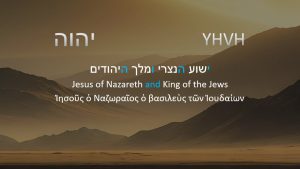
For the chief priests, who had accused Jesus of blasphemy (Mark 14:64), this acrostic would have been unbearable. Whether Pilate, a Roman pagan, understood the Hebrew acrostic is historically debatable. He may have learned enough from local informants or from his studies to be able to better govern a rebellious region. Josephus and Philo both document Pilate’s pattern of antagonizing Jewish sensibilities (e.g., bringing Roman standards into Jerusalem). The acrostic would have been the perfect weapon: invisible to most Romans and Greeks but screaming humiliating blasphemy to every literate Jew. By refusing to alter the inscription (which would have destroyed the acrostic with YHVH in it!), Pilate forced the Jewish authorities to stand beneath a sign that implicitly identified the man they had condemned with the divine name they claimed to honor and love.
If this article helped you see Scripture with fresh eyes, would you consider helping others do the same? Your support enables me to keep teaching, writing, and personally engaging pastors, priests, Bible teachers, and serious students of Scripture around the world.
A monthly gift provides the steady foundation this ministry needs. A one-time gift also makes a real difference. To support, click HERE or below.
Comments (27)
This was truly amazing. Your articles are informative and eyeopening to those of us who read and study the Bible from a western perspective. I plan to start supporting your valuable ministry on a monthly basis beginning in July. I would consider it an honor and a privilege to do so. God bless.
It would be an honor and a privilege to partner with you!
I love this theological view of pilate as illustrated and explained by you. Beyond how we ignorantly view him before as a theology student I am greatly bless with this. Thank you greatly again. From Nigeria
Blessings!
Dear Dr Eli Pilate in my view is an evil roman governor, the proof is Matthew 27:19, what do you think?
I think you are rihgt. It was in his power not to crusify Jesus, but he did.
Is there more information that you have that would dispel the supposition that this seems to be and make this a more substantial interpretation?
Not really, Pastor Rodney; this is simply a possibility, not certainty.
I had read of the acrostic in one of Misslers books, but this explanation is thorough I it's context. Superb article
Thank you, Mitah!
This conversation is possible because friends and family choose to support this ministry (Thank you so much!). If my teaching has helped you read the Bible more deeply in its Hebrew and Jewish world, and if you are in a position to do so, please consider joining my support team or giving again if you did in the past. Your monthly gift, no matter the size, helps me continue teaching, writing, and engaging with pastors, priests, Bible teachers, and serious students of Scripture worldwide. To support my work, click HERE.
This acrostic occurs on the assumption that the inscription written by Pilate is the second version (ישוע הנצרי ומלך היהודים) and not the first version (ישוע הנצרי מלך היהודים), is my statement correct? What word distinguishes between the first and second versions? (in English)
Your statement is correct. in English (and whenever one translates there are several ways that you can translate, most of which are good).
I am definitely learning something from your Hebrew and Greek translations. Really appreciate this!!!
So glad to hear!
Yes, Pilate had done a correct thing by pointing to all that YHVH was crucified (for all men’s sins), though for the purpose of humiliating the Sadducees.
But he had also done a horrible thing, trying to release Jesus Christ but orchestrated to get Isaiah 53:5 fulfilled. He flogged Jesus (even to death) without any reason (except to fulfil prophecy that he never thought of). Pilate could not wash hand for this crime of hurting the innocent.
Nevertheless, we genuine believers of Jesus Christ should ‘thank’ Pilate because his cruel action provides us a way of GOOD HEALTH because of Jesus’ flogging. By His stripes we are healed. Hallelujah.
Jesus is probably the only one that suffered both flogging and crucifixion in history.
Praise the Lord.
Thank you for sharing.
Logical and totally plausible. Thank you, Dr. Eli.
You are welcome, Bobbie.
Thanks. That was awesome. So interesting
Blessings!
This conversation is possible because friends and family choose to support this ministry (Thank you so much!). If my teaching has helped you read the Bible more deeply in its Hebrew and Jewish world, and if you are in a position to do so, please consider joining my support team or giving again if you did in the past. Your monthly gift, no matter the size, helps me continue teaching, writing, and engaging with pastors, priests, Bible teachers, and serious students of Scripture worldwide. To support my work, click HERE.