





The Untold Story of Moriah
Discover what deeper meaning is not seen in our Bible translations
Discover what deeper meaning is not seen in our Bible translations

Time to read: 7 minutes.
According to Jewish tradition, Abraham underwent ten significant tests. Genesis does not provide an official list, and later Jewish interpreters counted the tests in different ways. Nevertheless, the binding of Isaac was commonly understood as the final and greatest trial. In Genesis 22, God commands Abraham to take Isaac, the son whom he loves, and offer him as a burnt offering on a mountain that God will show him (Gen 22:1-19).
We read:
“Take your son, your favored one, the one whom you love, Isaac” (Gen 22:2).
The Hebrew text piles phrase upon phrase with escalating intensity: בִּנְךָ (binkha, “your son”), יְחִידְךָ (yechidkha, “your only one” or “your unique one”), אֲשֶׁר אָהַבְתָּ (asher ahavta, “whom you love”), and יִצְחָק (Yitzchak, “Isaac”). By the time the sentence reaches the name, the reader is breathless. This moment is no abstraction. This is the child of laughter, the miracle son, and the one through whom God had promised to continue the covenantal line, now commanded to become a burnt offering.
Three times in this story, Abraham responds with the same word: הִנֵּנִי (hineini). English cannot fully reproduce its personal force. “Here I am” may sound ordinary, but the Hebrew conveys attentive presence and availability: “I am here, ready to listen.” It places the speaker fully before the one who has called.
Because English translations sometimes vary the wording, readers may miss the threefold repetition. Abraham uses this phrase three times in this passage. He says it to God in verse 1. He says it to Isaac in verse 7 (where some translations render it simply as “Yes”). He says it to the angel in verse 11. Between these three statements of “hineini,” a universe of faith unfolds.
The narrator refuses to tell us what Abraham felt. We see only actions: rising early, saddling the donkey, splitting the wood, and traveling for three days. Three days of carrying the weight of the command. Three days of walking beside the son he had been told to offer. The narrator gives us no conversation from the journey until Isaac finally speaks.
When Abraham finally speaks to his servants, he says something astonishing: “We will worship and return to you” (Gen 22:5). Not “I will return.” We will return. Interpreters have explained Abraham’s words in several ways. He may have been concealing his purpose from the servants, expressing hope that God would intervene, or speaking with a faith deeper than his own understanding. The New Testament offers a particularly striking interpretation: Abraham trusted that God could restore Isaac even from death. Hebrews 11:19 makes this point explicit: “He considered that God is able to raise people even from the dead” and, figuratively speaking, received Isaac back from death.
At the moment Abraham’s hand lifted the knife, the angel cried out, “Do not lay your hand on the boy!” (Gen 22:12). Then comes the theological shock: “Now I know that you fear God, because you have not withheld your son, your only son, from Me.”
Now God knows? Did He not know before?
The text does not resolve the philosophical question directly. Some interpreters understand these words as the language of demonstrated knowledge. Abraham’s fear of God has now been enacted within history, not merely known as a possibility. What was hidden has become visible through obedience. The test did not provide God with information in the ordinary human sense. It brought Abraham’s faith into concrete and public expression.
Abraham looks up and sees a ram caught by its horns. The substitution is not a rejection of sacrifice but its redirection. A midrash (a Jewish interpretive tradition) portrays Abraham praying, “May it be regarded as if the blood of this ram were the blood of my son Isaac.” The ram dies in Isaac’s place, but Isaac has already died in Abraham’s heart. That is why the angel speaks of the son as not withheld. The offering was complete before the knife struck.
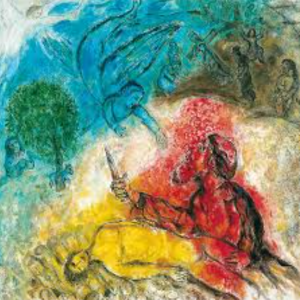
Marc Chagall’s 1966 painting The Sacrifice of Isaac captures what words cannot fully express. In his vision, the cross is already present at Moriah, hovering above the scene. As Abraham raises the knife, blood streams down from the cross and from the figure carrying it toward the altar where Isaac is bound. The crimson river flows directly onto the place where Isaac lies. The ram is there too, but the blood tells the deeper story: the altar where Isaac was bound and the cross above are mysteriously connected.
A Jewish Pharisee who encountered the risen Christ Jesus, whom we know today as the Apostle Paul, once asked a rhetorical question on behalf of struggling congregations and persecuted early Christ followers in Rome:
“He who did not spare His own Son but delivered Him over for us all, how will He not also, with Him, graciously give us all things?” (Rom 8:32)
Both the Apostle Paul and Marc Chagall understood that just as Abraham was called to demonstrate his love for the LORD, so the LORD Himself would reveal His love by offering His only and unique Son, Jesus (John 3:16).
Here is the truth the mountain teaches: God asked Abraham to demonstrate his complete and total commitment to Him, and then the LORD revealed that He was willing to do the same. Not only could God trust Abraham, but Abraham, representing all of his children, could also learn to trust God completely.
God did not withhold His beloved Son, Jesus. This is the God whom I can trust. And so can you.
If this article helped you see Scripture with fresh eyes, would you consider helping others do the same? Your support enables me to keep teaching, writing, and personally engaging pastors, priests, Bible teachers, and serious students of Scripture around the world.
A monthly gift provides the steady foundation this ministry needs. A one-time gift also makes a real difference. To support, click HERE or below.
Comments (40)
"The ram dies in Isaac’s place, but Isaac has already died in Abraham’s heart. That is why the angel speaks of the son as not withheld. The offering was complete before the knife struck."
You write that "Isaac ha already died in Abraham's heart." Why is this correct? Isaac did not really die. But the The Angel of the Lord said, "... you have done this and have not withheld your son, your only son ..." Is the reason that Isaac has already died in Abraham's heart the word "you have not withheld your son?"
I look forward to your comments.
I am very thankful for sharing the story of Abraham and Isaac.
Dear Dagfinn, first of all, thank you for your support! I think it is "as if he already died" that I think is the argument in Hebrews; figuratively, Abraham received him back from the dead.
Issac the representation of a living the sacrifice which Yeshua is the ultimate sacrifice. The ram becomes the replacement until the fulfillment of the true sacrifice. The parallelism of the two actions is the fulfillment of the covenant
Thank you for sharing!
Thankyou Dr.Eli, you are very insightful as a Christian and Jewish theologian. Your interpretations bring meaning to Scripture in the new and old testament. Jesus Christ is the substitutionary sacrifice I stead of the lamb or animal sacrifice, this time God offered His only Son for the redemption of fallen humanity once and for all. God bless
God bless you, Stanley!
Gratidão.
Isaac “where’s the lamb?”
Abraham “God will provide a lamb”
But God provided a ram, the lamb He would provide 2,000 years later!
Kevin, thank you for sharing.
This conversation is possible because friends and family choose to support this ministry (Thank you so much!). If my teaching has helped you read the Bible more deeply in its Hebrew and Jewish world, and if you are in a position to do so, please consider joining my support team or giving again if you did in the past. Your monthly gift, no matter the size, helps me continue teaching, writing, and engaging with pastors, priests, Bible teachers, and serious students of Scripture worldwide. To support my work, click HERE.
Yes, I trust that God wanted His friend Abraham (Isaiah 41:8) to rehearse His sacrifice of His Only Son (that Isaac was actually not Abraham’s only son).
In some extent God should have told some details to his friend Abraham (John 15:15), and that’s why Abraham responded as if Isaac would resurrect.
Anyway, even the places of both sacrifices lie in the same region, Moriah.
Praise the Lord.
Thank you for sharing, Eddie!
I would like to read the analysis from the son's point of view, Isaac's, what he felt, how he reacted... how he understood being the sacrifice.
I would too, Eduardo.
Galat.3:14 That the blessing of Abraham might come on the Gentiles through Jesus Christ; that we might receive the promise of the Spirit through faith.
Through this successful test that Abraham passed, God demonstrated Abraham's trustworthiness and created the conditions to bless him and all of humanity.Galat.3:14 That the blessing of Abraham might come on the Gentiles through Jesus Christ; that we might receive the promise of the Spirit through faith.
Thank you for sharing, Mpekos. You may be happy to know that we just began transalting the site to GREEK, I think we already have several articles translated.
Eli, your last sentence is the expression of the unity in the Spirit why I AM ONE with you in Christ. Abraham knew the Creator of the Heavens and the Earth has the Power to resurrect the Dead, especially resurrecting the Spiritually Dead walking this Earth before God recalls the Life giving Spirit.
Our Lord said it, Before Abraham I AM!
The Architecture of Indifference and the Awakening of the I AM
Thank you, Ray for sharing.
This conversation is possible because friends and family choose to support this ministry (Thank you so much!). If my teaching has helped you read the Bible more deeply in its Hebrew and Jewish world, and if you are in a position to do so, please consider joining my support team or giving again if you did in the past. Your monthly gift, no matter the size, helps me continue teaching, writing, and engaging with pastors, priests, Bible teachers, and serious students of Scripture worldwide. To support my work, click HERE.