



Why did God try to kill Moses?
Discover the bizarre tale of Zipporah’s quick thinking in saving Moses from sure death.
Discover the bizarre tale of Zipporah’s quick thinking in saving Moses from sure death.

By Dr. Eli Lizorkin-Girzhel (read bio)
Reading time: 7 min. Impact: Eternity.
One of the Torah’s most baffling episodes, which clashes with modern cultural sensibilities, unfolds in Exodus 4:24-26. Here, right after commissioning Moses to lead the Israelites out of Egypt, God unexpectedly tried to kill him. What follows is a cryptic scene involving Zipporah, Moses, one of their sons, and their Holy God.
The story and its ambiguity
וַיְהִי בַדֶּרֶךְ בַּמָּלוֹן וַיִּפְגְּשֵׁהוּ יְהוָה וַיְבַקֵּשׁ הֲמִיתוֹ
It happened on the way at the lodging place that YHWH met him and sought to cause his death (וַיְבַקֵּשׁ הֲמִיתוֹ; vay’vakkesh hamito).
וַתִּקַּח צִפֹּרָה צֹר וַתִּכְרֹת אֵת עָרְלַת בְּנָהּ וַתַּגַּע לְרַגְלָיו וַתֹּאמֶר כִּי חֲתַן-דָּמִים אַתָּה לִי
Then Zipporah took a flint (צֹר; tzor) and cut off her son’s foreskin and touched his feet (וַתַּגַּע לְרַגְלָיו; vataga l’raglav), and she said, “Indeed, a bridegroom of blood you are to me! (חֲתַן-דָּמִים אַתָּה לִי; khatan damim ata li)”
וַיִּרֶף מִמֶּנּוּ אָז אָמְרָה חֲתַן-דָּמִים לַמּוּלֹת
So He relented from him. At that time, she said, “A bridegroom of blood,” because of the circumcision. (Ex 4:24-26)
Sometimes the Torah is too terse, resulting in ambiguity. This text is no exception. While this lack of explanatory information may in fact be intentional, it frequently creates frustration among Bible interpreters.
You should always keep in mind that if you stumble on something weird in the Bible (that does not make any sense), it is probably extraordinarily important. In other words, the oddness of any text may be there to draw your attention to it, encouraging you to linger.
From our terse text (Ex 4:24-26), it is not even clear that God sought the death of Moses. It may very well be that He sought to take the life of Moses’ son instead. The son’s name is not specified, but the most likely candidate is Gershom (Ex 2:22). Second son Eliezer appears only later in the narrative (Ex 18:3). But why would we even consider God threatening Moses’s son with death? The short answer is context.
Immediate Before and After Context
Whenever we seek to understand Biblical texts, especially one as notoriously difficult, we must take the time to examine what happens immediately before and after to see how the text fits its context. It turns out that both the preceding and following texts involve God’s firstborn son—Israel. This is significant because Gershom, whom Zipporah circumcises, is the firstborn of Moses and Zipporah.
We read in the text that comes immediately before as God instructs Moses about his coming meeting with the Pharaoh of Egypt:
22 Then you shall say to Pharaoh, ‘This is what the Lord says: “Israel is My son, My firstborn. 23 So I said to you, ‘Let My son go so that he may serve Me’; but you have refused to let him go. Behold, I am going to kill your son, your firstborn.”’ (Ex 4:22-23)
The text that follows our enigmatic passage affirms that Moses’ God is deeply concerned about the children of Israel (Ex 4:27-31).
If it is true that God sought the death of Moses’ son, then the earlier threat of taking the firstborn son of Pharaoh would now apply to the firstborn son of disobedient Moses as well.
Now that we see the immediate context, we are ready to seriously consider what transpires in the text sandwiched between the two passages just quoted.
The Elephant in the Room
Zipporah resolves the situation by circumcising her son and then touching Moses with the bloody piece of Gershom’s foreskin, declaring that after her action, Moses finally became the “bridegroom of blood for her.” It is most logical to assume that neither Gershom nor Moses was circumcised in accordance with the covenant demands of Israel’s God. Later in the Book of Joshua, the same situation repeats itself with a whole new generation of the sons of Israel. A second nationwide circumcision needed to be performed. (Josh 5:2-7)
But you may ask, how could Gershom, the firstborn son of Moses, and Moses himself not have been circumcised? Several possibilities exist, but in Moses’ case, the most logical explanation is that he considered himself already circumcised. Raised in Pharaoh’s palace, Moses grew up as an Egyptian prince, surrounded by a culture where the male members of the elites were circumcised. However, his circumcision was not performed as a covenant with the God of Abraham, Isaac, and Jacob, but rather in accordance with Egyptian circumcision practice.
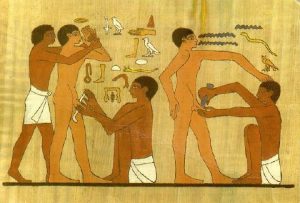
A Tomb relief at Ankhmaho, Saqqara (2350-2000 BCE/CE)
It is plausible that Zipporah and Moses disagreed on this matter. Zipporah may have believed that Moses should have been properly circumcised long ago, while Moses held a different view. Alternatively, Zipporah might have been aware of Moses’ desire to be circumcised correctly but knew he had been procrastinating on this important issue. Either way, Zipporah seemed to know exactly what needed to be done to avert tragedy.
When you finish reading this article, please make your contribution to help grow this ministry and reach more people. You can do so even now by clicking HERE and continue once you have done so. Dr. Eli will be very grateful!
To us, the modern (mostly Christian) readers, this emphasis on circumcision may sound misplaced. Why would God care so much about a physical mark? But for YHWH, circumcision was non-negotiable. It was the sign of the Abrahamic covenant for all Israelites (Genesis 17:10-14).
The penis was circumcised, not the nose or fingers, because God owned the man and his descendants. The physical sign was only given to men, but it was also important for wives to know their homes belonged to the LORD.
To be uncircumcised—or improperly circumcised—was to stand outside that covenant, a serious breach for any Israelite, let alone the leader of the Exodus. Moses was about to spearhead “Operation Exodus,” the greatest act of divine deliverance in Israel’s history. Yet probably he and certainly his firstborn son Gershom, lacked the all-important covenantal sign. This wasn’t a minor oversight. It was a serious disqualification to his fitness as God’s chosen emissary.
Zipporah’s Intervention
Enter Zipporah, Moses’ Midianite wife, who emerges as the unsung hero of this drama. When God confronts Moses with deadly intent (וַיְבַקֵּשׁ הֲמִיתוֹ, vay’vaqqesh hamito), Zipporah acts swiftly. Grabbing a knife made out of stone, she cuts off her son’s foreskin, and with it she touches Moses’ feet (וַתַּגַּע לְרַגְלָיו, vattaga l’raglav). Then she utters her enigmatic words: “Surely you are a bridegroom of blood to me” (כִּי חֲתַן-דָּמִים אַתָּה לִי, ki chatan-damim atah li). Immediately, God relents, and Moses is spared.
What’s going on here? Let’s unpack it step by step.
First, she clearly knows that this has to do with circumcision. Otherwise, she would not be able to act so quickly to remedy the situation. By circumcising Gershom, she addresses the covenantal failure in her husband. But why touch the foreskin to Moses’ “feet”? The Hebrew word רַגְלָיו (raglav, “feet”) is often a euphemism for the male reproductive organ in the Hebrew Bible (see, for example, Ruth 3:7 or Isaiah 7:20). It’s likely that Zipporah, after circumcising Gershom, symbolically transferred Gershom’s circumcision to Moses. In doing so, she declared Moses to be in the right standing with God, as if he himself bore the proper sign.
We can’t be sure of every detail in this event. After all, Moses might have been circumcised but neglected to circumcise his son. In this scenario Zipporah may have performed the circumcision of Gershom and credited Moses with doing the job he was supposed to have done. But this brings us to her words: “bridegroom of blood to me.” The Hebrew phrase חֲתַן-דָּמִים (chatan-damim) is striking. A חֲתַן (chatan) is a bridegroom, and דָּמִים (damim) refers to blood. Zipporah’s declaration suggests that circumcision isn’t just an important sign between God and a male participant. It’s also a sign that reverberates through the marriage relationship and, therefore, has relevance to the woman as well. For a woman like Zipporah, marrying a man of the covenant with YHWH meant marrying someone marked by this bloody rite we call circumcision. (Rituals involving blood were well known in Bible times, and as was the case with Passover sacrifice, they were salvific in nature). A properly circumcised man was a “bridegroom of blood” to his bride, proof that he worshiped the God of Abraham, Isaac, and Jacob. By performing the circumcision and touching Moses’ “feet,” Zipporah symbolically restores Moses to covenantal faithfulness, ensuring that he’s a true “bridegroom of (covenantal) blood” to her.
Higher Standard
God could tolerate an uncircumcised Israel for a time—they were, after all, slaves in Egypt—but Moses, the leader of the massive exodus, who would soon speak before Pharaoh representing YHWH, had to answer to a higher standard.
Let us illustrate. In the New Testament, several passages outline qualifications for the role of an elder (servant leader) in a local congregation. At a time when polygamy was a widely accepted cultural norm, an elder in a Christ-following congregation was required to be married to only one woman (the husband of one wife). Although polygamy was not explicitly forbidden for all believers, church elders were held to a higher standard, reflecting the original monogamous relationship between Adam and Eve. (1 Tim 3:2; Titus 1:6)
The qualifications for elders in 1 Timothy 3 and Titus 1 emphasize exemplary character (“above reproach”), suggesting that elders were to model the highest ethical and spiritual standards. By requiring monogamy, the early church ensured that its leaders reflected the biblical ideal of marriage, even in cultures where polygamy was acceptable. This higher standard aligned with the church’s mission to distinguish itself from surrounding cultural practices and to embody God’s design for human relationships.
Conclusion
Exodus 4:24-26, though cryptic, unveils a timeless truth: God’s covenant demands unwavering commitment, igniting inspiration for us today. Circumcision was no mere ritual but a sacred bond uniting Israel to God. Zipporah’s courageous act—circumcising her son and symbolically restoring Moses to the covenant—transformed a moment of divine judgment into redemption, mirroring the Passover’s saving blood. As a Midianite, daughter of priest Jethro, she became a beacon of faith, securing Moses’ mission to lead Israel to freedom. Her story calls us to rise above fear and cultural norms, embracing God’s call with bold obedience. Like Zipporah, we can wield faith as a flint, cutting through doubt to align with divine purpose. Her legacy inspires us to act decisively, trusting that our faithfulness can spark transformation, bridge heaven and earth, and carry forward God’s redemptive plan for the world.
Partner with Dr. Eli today! Whether you choose a one-time gift or a monthly partnership (moderate or large), every contribution (and this is absolutely true!) will impact the lives we will serve together. Click HERE or below.
Comments (64)
This was an excellent explanation!!!
Thanks, Kris!
Thank you for this. I always thought Zipporah's reaction toward Moses was because she was of pagan background and angry that a g(G)od would demand the cutting of flesh as a means of identification of his faith.
No, she is a positive agent in the story.
The entire premise is flawed; How can an Almighty God "try" to kill a mere mortal and fail? If you really consider the background given you will come to realise the real reason the angel was there, and perhaps even realise the comparison between Abraham and Moses. I am surprised at the ready institutionalised acceptance of narratives like this without a single question being raised...
Thank you, Dr. Eli. I am grateful for the reference you provided, and will read it carefully and consider the contents thereof.
Dr. Eli, thanks for the response. I note that you did not address the issue of whether it is conceivable that God could fail to kill a human he wished dead; Based on the covenant that no uncircumcised male may enter the Covenant, I posit that the angel was there to kill the child if he remained uncircumcised, and Zipporah resolved the matter when Moses refused to do so. The contrast between Abraham and Moses is stark here, and since Moses remained disobedient to the end, even risking his son's life, if the angel was there to kill him for that reason then Moses should be dead. It also explain Zipporah's remarks to a husband that had endangered their son's life.
Tony, thanks for your reply. I recommend you read this very carefully. We can then continue the conversation offline if you wish - https://thirdmill.org/magazine/article.asp/link/http%3A%5E%5Ethirdmill.org%5Earticles%5Eric_pratt%5ETH.Pratt.Historical_Contingencies.html/at/Historical+Contingencies+and+Biblical+Predictions
It's amazing how people can sometimes say a lot and nothing at the same time. Please, argue and make your case. We will consider.
JPS Exo 2:1 And there went a man of the house of Levi, and took to wife a daughter of Levi.
Exo 2:2 And the woman conceived, and bore a son; and when she saw him that he was a goodly child, she hid him three months.
Assuming Moses's parents circumcised Moses to be a part of Abraham's covenant seems reasonable to me. As circumcision is to be done on the eighth day, hiding him for 3 months would allow enough time, to not do it would be disobedient. So I think it is just Gershom being circumcized. Thoughts?
I think it is possible, but it is no more likely than what I suggest. :-) When we do reconstruction like that, we deal with possibilities and plausibilities, not with certainties :-). Drives some people crazy :-).
This is very great.
I've been inspired by this revelation
Blessings!
I am so grateful to those of you who have decided to help me grow this ministry! May God bless you and keep you! If you are interested in making a contribution of any size, whether one- time or ongoing, please click here.
Thank you for the insights. But if Moses stayed with his parents for three months before being floated down the river, as stated in Scripture, how can you assume he hadn’t been circumcised on the eighth day?
Janet, hi. The answer is simple: they knew that it ALONE may save his life. That was their plan and it worked.
Understood her action to her elder son and then to her husband Moses, thank you for your interpretation.
Blessings and peace!
Thank you. This has been my question and i am privileged to find that you have helped answer even before i had the time to ask directly. Am grateful to find answers to too many scripture questions i have on your blog.
Eli,
In the above article you use YHWH two times and then twice YHVH. You may want to pick either one and use it throughout for consistency. Just a thought.
Colleen
Colleen, thank you so much! Fixed the inconsistency.
Thank-you Dr. Eli! Your explanations add so much insight to the Bible verses that I would have never known the underlying meanings had you not explained them in depth.
Mindy, yes, we need to always look for context to understand the text; otherwise, we will impose new meaning on it.
I am so grateful to those of you who have decided to help me grow this ministry! May God bless you and keep you! If you are interested in making a contribution of any size, whether one- time or ongoing, please click here.