




Take Your Son, The One You Love
Discover what deeper meaing is not seen in our Bible translations
Discover what deeper meaing is not seen in our Bible translations
By Dr. Eli Lizorkin-Girzhel (read bio)
Reading time: 7 min. Impact: Eternity.
Before Genesis 22, Abraham had already been tested nine times. Various versions of Jewish tradition include ten events in Abram/Abraham’s time when his faith in YHVH was significantly tested, but none rivaled the last, tenth test. The Binding of Isaac describes God’s command to Abraham to take his only son, whom he loved, and offer him as a burnt offering on a mountain that God would show him (Gen 22:1-19).
We read:
“Take your son, your favored one, the one whom you love, Isaac” (Gen 22:2).
The Hebrew piles phrase upon phrase with escalating intensity: בִּנְךָ (bin’kha, “your son”), יְחִידְךָ (y’chid’kha, “your only/unique one”), אֲשֶׁר אָהַבְתָּ (asher ahav’ta, “whom you love”), and יִצְחָק (Yitzchak, “Isaac”). By the time the sentence reaches the name, the reader is breathless. This moment is no abstraction. This is the child of laughter, the miracle son, the entire future of God’s covenant—now ordered to become a burnt offering.
The Refrain of Readiness
Three times in this story, Abraham responds with the same word: הִנֵּנִי (hineini). English cannot capture its density—”Here I am” flattens what the Hebrew conveys: complete presence, body, mind, and will, fully oriented toward the one who calls. It is the response of a servant who has already decided to obey before knowing the command.
Though we usually can’t see this in translation, in Hebrew Abraham uses this phrase three times in this one text. He says it to God in verse 1. He says it to Isaac in verse 7 (where translations render it weakly as “Yes”). He says it to the angel in verse 11. Between these three “hineini” statements, a universe of faith unfolds.
The Silent Journey
The narrator refuses to tell us what Abraham felt. We see only actions: rising early, saddling the donkey, splitting wood, and traveling three days. Three days of knowing what awaits. Three days of walking beside the son he intends to kill. Three days of silence.
When Abraham finally speaks to his servants, he says something astonishing: “We will worship and return to you” (Gen 22:5). Not “I will return.” We will return. Hebrew scholars note that this statement is either deception, self-deception, or prophecy. Abraham may be concealing the truth from his servants (lest they intervene), from Isaac (lest he flee), or from himself (lest his resolve shatter). But the text offers a more profound possibility: Abraham genuinely believes that God will raise Isaac from the dead. Hebrews 11:19 makes this point explicit: “He considered that God is able to raise people even from the dead.”
The Knife That Fell
When you finish reading this article, please make your contribution to help grow this ministry and reach more people. You can do so even now by clicking HERE and continue once you have done so. Dr. Eli will be very grateful!
At the moment Abraham’s hand lifted the knife, the angel cried out, “Do not lay your hand on the boy!” (Gen 22:12). Then the theological bombshell: “Now I know that you fear God, because you have not withheld your son, your only son, from Me.”
Now God knows? Did He not know before?
God knew Abraham would obey. But Abraham needed to know. And the world needed to know. The עֲקֵדָה (Akedah, “binding”) became the proof that a human being could love God more than life itself—more than the promised future, more than the miracle child, more than all the hopes and dreams.
Isaac, Ram and Jesus
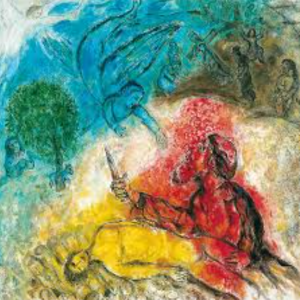 Abraham looks up and sees a ram caught by its horns. The substitution is not a rejection of sacrifice but its redirection. A midrash (a Jewish interpretive story) has Abraham pray, “May it be regarded as if the blood of this ram were the blood of my son Isaac.” The ram dies in Isaac’s place, but Isaac has already died in Abraham’s heart. That is why the angel speaks of the son as not withheld—the offering was complete before the knife struck.
Marc Chagall’s 1966 painting The Sacrifice of Isaac captures what words cannot fully express (Chagall is a Russian Jewish, later French, artist). In Chagall’s vision, the cross is already present at Moriah, hovering as he pictured it somewhere above. As Abraham raises the knife, blood streams down from the cross and the man carrying it to the altar where Isaac is bound. The crimson river pours directly onto the altar where Isaac lies bound. The ram is there too, but the blood tells the truer story: the altar, where Isaac was bound, and the cross above are intricately connected.
A Jewish pharisee, who had met a risen Christ Jesus, whom today we call Apostle Paul, once asked a rhetorical question on behalf of struggling congregations or persecuted early Christ followers in Rome.
He who did not spare His own Son but delivered Him over for us all—how will He not also, with Him, graciously give us all things? (Rom 8:32)
Both Apostle Paul and Marc Chagall understood that just as Abraham was supposed to show God, himself, and others his love for the LORD, so did the LORD have to show his love by offering his only and unique son, Jesus! (John 3:16)
Conclusion
Here is the truth the mountain teaches: God asked Abraham to show his utter and total commitment to Him, and then the LORD showed that He was willing to do exactly the same. Not only could God trust Abraham, but Abraham, as represented by all of his children, can do the same! God did not stop Himself from giving up His beloved Son, Jesus. This is the God that I can trust. And so can you.
Partner with Dr. Eli today! Whether you choose a one-time gift or a monthly partnership (moderate or large), every contribution (and this is absolutely true!) will impact the lives we will serve together. Click HERE or below.
Comments (25)
At every point where human beings act as human beings and are called to have faith in the Father it is Christ Jesus who takes our place.
Thank you for sharing.
This is so moving. I am left in tears at this revelation of the magnitude of God's compassion and love. And I am compelled to examine my own heart and pray the Lord will help me to love him with such abandon. I love this sentence about "hineini"..."It is the response of a servant who has already decided to obey before knowing the command."
May the Lord grant us a grater measure of faith!
Would we followers of Yeshuah today, upon hearing a Voice instructing us to do evil—Big Time Evil—not say, "That's the voice of HaSatan. Ignore it"?
What is your answer?
This relinquishment established him as the Father God needed him to be. To me, he represents Adams test reimagined. There was only 1 woman to say no too. If Adam had said no, even though the woman said yes, he would have laid down his own needs- to put Gods command first. The Father he was meant to be would have risen. Abraham reclaimed that great test, he laid down his son, the only one that had Gods promise attached, and the Father of faith was born, from which the linage of Christ would come.
I find it fascinating.
thank you for sharing, Jeanet.
Yeah, well ,Yitzchak was spared and Jesus was not but was killed by Romans.
God forbid killing children as offer to please deities but in christian view he contradicts himself by allowing Jesus to be killed.
In the Gospel according to John, Jesus is recorded as contending that no one takes his life. and that the reason (and source?) of his Father's love for him actually lies in his laying down [his life] and taking it up again. That the triune God is so far beyond human understanding, does not demean its truth. Rather it justifies and glorifies truth in "the Way, the Truth and the Life" by which we are enabled to "come to the Father." Such love cannot be understood; it must be received and returned.
Thanks for space to share insights, Dr. Eli!
In Christ's service,
Carol
You are welcome, Carol! Thank you for sharing!
Thank you for sharing.
I am so grateful to those of you who have decided to help me grow this ministry! May God bless you and keep you! If you are interested in making a contribution of any size, whether one- time or ongoing, please click here.
THANKS SO MUCH FOR THE DEEP INSIGHTS AND DEEPER UNDERSTANDING THAT COMES OUT OF THE TEACHING'S. MAY GOD CONTINUE TO STRENGTHEN YOUR HOUSE.
Thank you so much!
Awesome. I love it.
This was really deep. I have been on a difficult journey of trust with God where He revealed the reasons we could trust Him by His various titles or names. Each gives us deeper reasons to trust. We cannot truly love someone if we dont trust them. So if we are commanded to Love God as per the Shema, then we must trust Him too with all we have
Blessings!
This experience could also have been used to liberate Abraham. One becomes what they worship (Ps 115:8; 135:18; 2 Cor 3:18). Worshipping anything other than God means we resemble a character that is not God's character, which would mean that it is flawed. Perhaps Abraham focused more on Isaac than God after waiting for a son for so long (it is the first use of "love" in the Bible). By refocusing Abraham's attention, Abraham was able to continue to grow in faith. Even though he had many flaws, his willingness to grow in faith made him an archetype of faith.
Thank you for sharing!
Correct me if I'm wrong, but didn't all of God's anointed servants, including Abraham, respond with "Here am I" as opposed to "Here I am?" I have a discernment regarding this detail.
From a linguistic standpoint, “Here am I” versus “Here I am” is largely a matter of older English word order, not a difference in meaning.
The parallel of the sacrifice of Issac and the all forgiveness of the sacrifice of Yeshua, is so much of what a glorious Father we have. For as Avram by faith believed in Adonai, so we by faith imparted in Yeshua believe in the Father.
Avram was willing to sacrifice his chosen Son, as YHVH gave His chosen Son for all of mankind. The redemption of love ,grace and glory.
Indeed
I am so grateful to those of you who have decided to help me grow this ministry! May God bless you and keep you! If you are interested in making a contribution of any size, whether one- time or ongoing, please click here.